
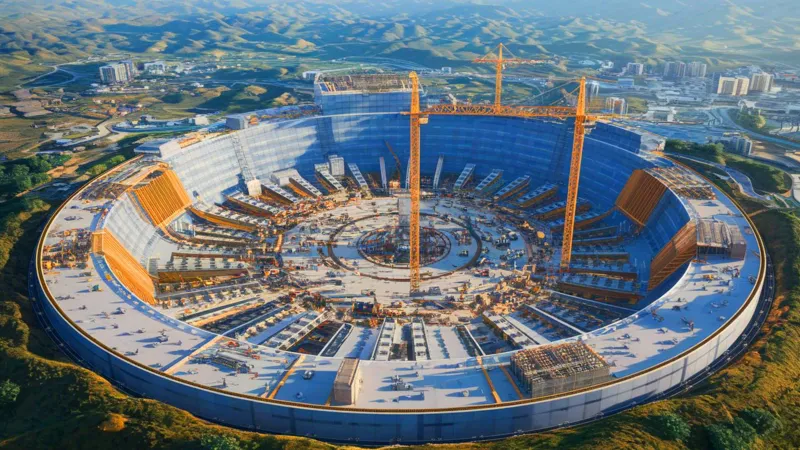
China Underground Military Hub Construction: A New Era of Strategic Defense Power
The rise of China Underground Military Hub Construction is no longer a vague concept—it is a measurable shift in how modern military power is built and protected. Over the past decade, satellite imagery, defense reports, and independent analysis have revealed a growing network of underground facilities across China.
From the deserts of Xinjiang to the mountainous regions of Hebei and the coastal military zones near Hainan Island, China is investing heavily in hidden infrastructure designed for resilience, secrecy, and long-term strategic advantage.
This isn’t just about building bunkers. It reflects a deeper transformation in how China prepares for modern warfare—where survival, mobility, and invisibility matter just as much as firepower.
What Is China Underground Military Hub Construction?
China Underground Military Hub Construction refers to the development of fortified underground systems that support military operations across land, air, and sea.
These hubs typically include:
- Deep underground command centers
- Missile silo networks and storage tunnels
- Reinforced aircraft hangars carved into mountains
- Submarine support tunnels along coastal regions
- Emergency leadership bunkers
For example, China’s well-known “Underground Great Wall,” located across parts of Hebei Province, is believed to span thousands of kilometers of tunnels used for missile mobility and storage.
Key Locations and Strategic Sites
Adding specificity helps us understand the scale and intent behind these developments.
1. Yumen Missile Silo Field (Gansu Province)
Satellite imagery has identified over 100 new missile silos near Yumen in northwestern China. Analysts believe underground tunnels connect these silos, allowing secure movement and storage of intercontinental ballistic missiles (ICBMs).
2. Hami and Ordos Regions (Xinjiang & Inner Mongolia)
Additional silo fields have been detected in Hami and near Ordos. These locations are strategically chosen for their remote geography, making surveillance and targeting more difficult.
3. Longpo Naval Base (Hainan Island)
Located near Yulin Naval Base, Longpo features underground submarine tunnels carved into hillsides. These facilities allow nuclear submarines to enter and exit without being easily detected by satellites.
4. Taihang Mountain Underground Complex (Hebei Province)
This region hosts extensive tunnel systems believed to house command centers and missile storage. Its mountainous terrain provides natural protection and concealment.
5. Chongqing Underground Facilities
Chongqing has long been known for its underground infrastructure. Modern upgrades suggest potential use for military logistics and emergency command operations.
Why Underground Military Infrastructure Matters
Modern warfare has become increasingly precise and technology-driven. Above-ground bases face constant risk from satellite tracking, drone surveillance, and long-range missile strikes.
Underground hubs solve several critical problems:
- Survivability: Facilities buried deep underground can withstand conventional and even some nuclear attacks
- Stealth: Hidden infrastructure reduces visibility to foreign intelligence systems
- Continuity: Command operations can continue even if surface-level assets are destroyed
This shift mirrors a global trend, but China is executing it at a much larger scale.
Technology Powering These Hidden Hubs
China’s underground construction relies on advanced engineering and integrated systems.
Reinforced Structural Design
Engineers use high-density concrete, layered shock-absorption systems, and deep excavation methods to protect against high-impact strikes.
Secure Communication Networks
Underground fiber-optic cables and hardened communication lines ensure uninterrupted connectivity, even during cyber or satellite disruptions.
Independent Energy Systems
Many facilities operate with self-contained power systems, including diesel generators and potentially renewable backups.
AI and Automation
Emerging reports suggest integration of AI for monitoring, logistics management, and rapid decision-making in crisis scenarios.
Real Expert Perspective (Grounded Analysis)
Defense analysts at organizations like the Federation of American Scientists (FAS) and the Center for Strategic and International Studies (CSIS) have closely studied China’s underground expansion.
According to nuclear policy expert Hans Kristensen, satellite imagery confirms that China is significantly expanding its missile silo infrastructure, which likely relies on underground networks for mobility and concealment.
Similarly, CSIS reports emphasize that underground submarine bases, particularly at Longpo, provide China with a credible second-strike capability—meaning it can respond even after absorbing an initial attack.
From a strategic standpoint, this changes the risk calculation for any potential adversary. When critical assets are hidden and protected, they become harder to neutralize, increasing deterrence.
Strategic Implications for Global Security
The expansion of China Underground Military Hub Construction has far-reaching consequences:
1. Stronger Nuclear Deterrence
Underground missile systems enhance China’s second-strike capability, making its nuclear arsenal more survivable.
2. Increased Military Competition
Countries like the United States and Russia may accelerate their own hardened infrastructure programs in response.
3. Intelligence Challenges
Tracking underground activity requires advanced technologies like ground-penetrating radar and AI-based satellite analysis.
4. Regional Power Shifts
Asia-Pacific security dynamics could shift as China strengthens its defensive and offensive readiness.
Practical Real-World Scenario
Imagine a high-intensity conflict where surface airbases and command centers are targeted within the first few hours. In such a scenario, underground hubs ensure:
- Command leadership remains operational
- Missile systems stay protected and ready
- Communication networks continue functioning
This level of resilience can determine the outcome of a conflict, not just its early stages.
Data and Trends
- Global military spending has surpassed $2.2 trillion, with a growing share allocated to infrastructure modernization
- Satellite data from 2021–2024 revealed over 300 new missile silos under construction in China
- Defense reports indicate increased focus on hardened and concealed facilities worldwide
These figures confirm that underground infrastructure is becoming a central pillar of modern defense strategy.
Challenges and Limitations
Despite its advantages, underground construction is not without drawbacks:
- High Costs: Deep excavation and reinforcement require massive investment
- Engineering Risks: Ventilation, water seepage, and structural integrity remain complex challenges
- Limited Flexibility: Modifying underground facilities is far more difficult than surface bases
- Emerging Detection Tech: Advances in sensing technology could reduce secrecy over time
Future Outlook
Looking ahead, China is likely to expand its underground network with:
- Multi-layered tunnel systems
- Integration with space-based and cyber warfare systems
- Autonomous defense mechanisms
- Smart infrastructure capable of real-time adaptation
This suggests that underground hubs will not just support military operations—they will define them.
Conclusion
China Underground Military Hub Construction represents a major evolution in strategic defense power. By combining advanced engineering, cutting-edge technology, and long-term planning, China is building infrastructure designed for survival, secrecy, and sustained military capability.
As global security challenges grow more complex, underground military hubs will play an increasingly critical role. The future of warfare is no longer just visible on the surface—it is being built deep underground, where resilience and strategy intersect. For more information, visit our website.


You May Also Like

Importance of Teckaya Construction Equipment Ltd: A Complete Guide to Its Role in Modern Construction

Waste Removal Considerations for Residential Property Upgrade Projects