
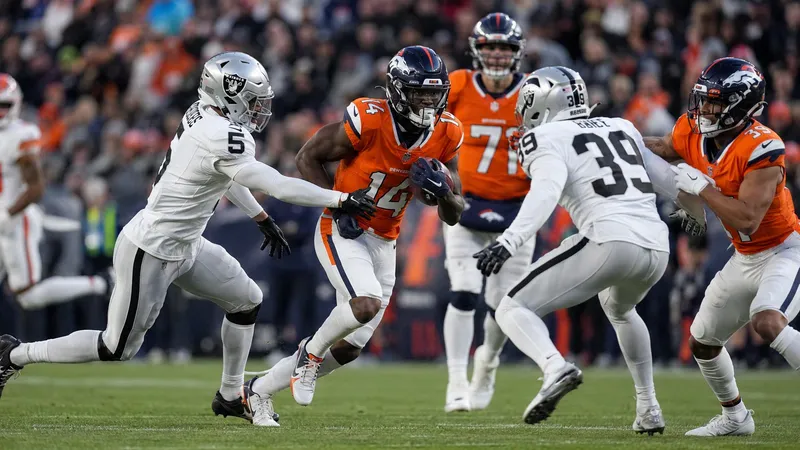
Las Vegas Raiders vs Denver Broncos Match Player Stats: Complete Breakdown
The Las Vegas Raiders vs Denver Broncos Match Player Stats tell a clear story about how this AFC West rivalry played out during the 2025 NFL season. Denver won both regular-season meetings, but the two games unfolded in very different ways.
The first matchup on November 6, 2025, ended with Denver winning 10-7 in a defensive battle. The second meeting on December 7 produced more offense, with the Broncos earning a 24-17 victory at Allegiant Stadium.
Looking beyond the final scores is important. Quarterback efficiency, rushing production, receiving targets, defensive pressure, and red-zone execution explain why Denver controlled the season series.
2025 Raiders vs Broncos Results
The two teams met twice in the 2025 regular season:
| Date | Location | Result |
|---|---|---|
| November 6, 2025 | Denver | Broncos 10, Raiders 7 |
| December 7, 2025 | Las Vegas | Broncos 24, Raiders 17 |
Denver therefore finished the season series with a 2-0 advantage.
The first game was especially defensive. Las Vegas scored its only touchdown in the opening quarter, while Denver responded with a touchdown in the second quarter and a field goal in the third. Neither team scored in the fourth quarter.
November 6: Broncos Win a Defensive Battle
The first meeting provides one of the clearest examples of why box-score context matters.
Denver quarterback Bo Nix completed 16 of 28 passes for 136 yards, one touchdown, and two interceptions. His passer rating was 54.2. Geno Smith completed 16 of 26 attempts for 143 yards, with no touchdowns and one interception.
Neither passing attack produced a big statistical performance.
Raiders Rushing
Ashton Jeanty led the Raiders on the ground with 19 carries for 60 yards and a touchdown. He averaged 3.2 yards per carry and recorded a long run of 10 yards.
Tre Tucker added seven rushing yards, while Geno Smith contributed seven. The Raiders finished with only 74 rushing yards on 25 attempts.
Broncos Rushing
J.K. Dobbins provided Denver’s strongest rushing performance. He carried the ball 18 times for 77 yards, averaging 4.3 yards per attempt.
RJ Harvey added nine yards on four carries, while Nix finished with negative rushing yardage. Overall, Denver produced 84 rushing yards on 27 attempts.
That modest advantage on the ground helped Denver maintain offensive balance in a game where neither quarterback was highly efficient.
Receiving Leaders From the First Meeting
Las Vegas spread its passing production around. Tyler Lockett led the Raiders with five receptions for 44 yards. Brock Bowers had one catch for 31 yards, while Tre Tucker caught two passes for 28 yards.
Denver’s most productive receiver was Pat Bryant, who caught one pass for 43 yards. Troy Franklin caught five passes for 40 yards and scored Denver’s only receiving touchdown. Courtland Sutton added three receptions for 24 yards.
One interesting detail is the lack of volume. Denver completed only 16 passes, while Las Vegas also completed 16. This was not a game dominated by high-volume passing.
December 7: Denver Pulls Away
The second meeting looked completely different.
Denver defeated Las Vegas 24-17 after leading 21-7 through three quarters. The Raiders scored 10 points in the fourth quarter, but the comeback came too late.
Bo Nix completed 31 of 38 passes for 212 yards. He did not throw a touchdown or interception and posted an 89.9 passer rating.
Las Vegas used both Geno Smith and Kenny Pickett. Smith completed 13 of 21 passes for 116 yards, one touchdown, and no interceptions. Pickett completed 8 of 11 for 97 yards and one touchdown. Together, the Raiders completed 21 of 32 passes for 189 yards and two touchdowns.
The quarterback numbers show an important difference from the first meeting: Denver’s Nix was much more efficient, while Las Vegas actually received strong production from its two quarterbacks but still could not generate enough offense to win.
Rushing Stats in the Second Game
Denver dominated the ground game.
RJ Harvey led all rushers with 17 carries for 75 yards and a touchdown. Adam Prentice added 22 yards on only two attempts, while Jaleel McLaughlin gained 22 yards on four carries.
Nix also contributed 15 rushing yards and a touchdown. Denver finished with 152 rushing yards on 31 attempts, averaging 4.9 yards per carry.
The Raiders struggled to establish their run game. Ashton Jeanty carried 10 times for only 30 yards, averaging exactly 3.0 yards per carry. Las Vegas finished with just 40 rushing yards.
This 112-yard difference in rushing production was one of the biggest statistical factors in the game.
Receiving Leaders in the Second Meeting
Courtland Sutton led Denver’s receivers with six catches for 62 yards on 10 targets. Pat Bryant recorded four receptions for 32 yards, while Lil’Jordan Humphrey added three catches for 27 yards.
RJ Harvey also caught six passes for 25 yards, showing how Denver used its running back in the passing game.
For Las Vegas, Jack Bech led the team with six receptions for 50 yards. Brock Bowers caught four passes for 46 yards and a touchdown, while Tyler Lockett added three receptions for 41 yards.
Shedrick Jackson also made an impact with one catch for 25 yards and a touchdown.
What the Player Stats Reveal
Looking at the Las Vegas Raiders vs denver broncos match player stats across both games reveals three major trends.
1. Denver’s Running Game Made the Difference
The Broncos consistently produced more on the ground.
In November, Denver gained 84 rushing yards compared with Las Vegas’ 74. In December, the gap became much larger: Denver gained 152 yards while the Raiders managed only 40.
That difference allowed Denver to control possessions and reduce pressure on Nix.
2. Bo Nix Improved Between Meetings
Nix struggled statistically in the first matchup, throwing two interceptions and only 136 yards.
In the rematch, he completed 31 of 38 passes for 212 yards without an interception. That represents a major improvement in accuracy and ball security.
3. Raiders Needed More From Their Ground Attack
Jeanty’s 60 rushing yards in the first game were respectable, but the Raiders still scored only seven points.
In the rematch, his workload fell to 10 carries for 30 yards. Las Vegas compensated somewhat through the passing game, but the offense could not match Denver’s 152 rushing yards.
Key Players to Watch
For anyone studying the Las Vegas Raiders vs Denver Broncos match player stats, several names stand out.
Bo Nix: His second-game efficiency was a major reason Denver won again.
RJ Harvey: His 75 rushing yards and rushing touchdown in December gave Denver a reliable offensive foundation.
Courtland Sutton: Sutton remained a consistent receiving option, particularly in the second matchup when he caught six passes.
Ashton Jeanty: Jeanty remained a central part of Las Vegas’ offense, but Denver’s defense limited his rushing efficiency.
Brock Bowers: His four catches for 46 yards and a touchdown in the second meeting showed why he remained an important matchup problem for Denver.
Final Takeaway
The Las Vegas Raiders vs Denver Broncos match player stats from 2025 show that Denver won the rivalry through balance rather than one overwhelming individual performance.
The Broncos won the first game 10-7 and the second 24-17. Their ability to run the football, protect the ball more effectively in the rematch, and generate consistent contributions from multiple players proved decisive.
For readers comparing individual performances, the biggest lesson is simple: raw passing yards do not tell the entire story. Denver’s rushing production, quarterback efficiency, and overall offensive balance helped turn two close AFC West games into two Broncos victories.
When evaluating future Las Vegas Raiders vs Denver Broncos match player stats, those same categories—passing efficiency, rushing success, receiving volume, turnovers, and defensive pressure—are worth checking before judging which team actually controlled the game. For more information, visit our website.

You May Also Like

LessInvest.com Real Estate: Complete Guide to Smart Property Investment 2026

Helpinus Nourishing Self: A Complete Guide to Inner Wellness